
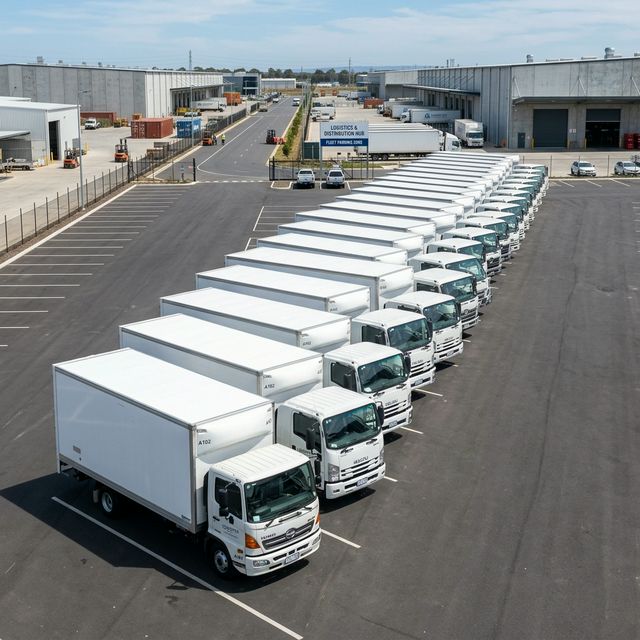
Are your commercial trucks sitting idle? Discover how the $10 Billion “empty mile” and idle capacity crisis is quietly draining private fleets across the Canadian supply chain.
If you manage a private commercial fleet—whether you run an HVAC company, a wholesale bakery, or a structural steel operation—you know that your trucks are the lifeblood of your business. But there is a silent, invisible cost eating into your profit margins every single week: Idling capacity.
In the logistics industry, a parked truck is a depreciating asset. Despite this, industry data reveals a mathematical nightmare: local private fleets frequently leave their commercial vehicles parked up to 40% of the time. Simultaneously, regional carriers drive nearly 30% of all highway miles completely empty (a phenomenon known as “deadheading”).
This structural inefficiency represents a staggering $10 Billion annual waste in the Canadian supply chain. The question is: why are we letting billions of dollars sit in parking lots?
The True Cost of a Parked Truck
When a 5-ton commercial box truck sits parked in your lot on a Tuesday afternoon, it isn’t just “not working.” It is actively costing your business money. Fleet managers are bleeding capital on fixed costs regardless of whether the wheels are turning:
- Commercial Insurance: Massive monthly premiums do not pause when the engine is off.
- Depreciation & Financing: Hardware degrades, and heavy lease payments are due regardless of usage or delivery volume.
- Driver Labor: If highly-skilled, licensed drivers are swept into warehouse duties because there are no deliveries booked, companies are losing severe labor productivity.
For decades, fleet managers have aggressively optimized their active routes, but have largely ignored their downtime, writing it off simply as the “cost of doing business.”
The B2B Insurance Trap
Why hasn’t the free market naturally solved this? If an HVAC company has an empty truck on a Friday, and a local event planner is desperate for a 5-ton truck for the weekend, why don’t they just share the vehicle?
The answer lies in the commercial insurance trap.
A private “Hardware-only” rental market cannot exist efficiently because commercial vehicle policies strictly forbid third-party, un-vetted drivers from taking the wheel of a corporate asset. If an HVAC owner hands their keys to an external driver, their entire National Safety Code (NSC) rating and cargo liability are instantly at risk.
Traditional truck rental giants (like Penske or Enterprise) survive by forcing desperate businesses to purchase incredibly expensive short-term liability insurance—acting as a massive barrier to entry for ad-hoc, hourly B2B capacity sharing.
The Looming Supply Chain Reckoning
The current model is mathematically unsustainable. We have two disconnected realities operating simultaneously: small businesses are losing sales because they cannot securely rent commercial hardware during delivery spikes, while heavy industrial fleets are bleeding fixed-cost capital on trucks that sit empty for three days a week.
The logistics market is evolving, and the fleets that survive the next decade will be the ones that recognize their trucks are not merely operational tools, but independent assets that require constant yield.
The Canadian supply chain desperately needs a structural loophole to the insurance trap—a secure, B2B framework that allows the seamless sharing of hardware and labor without exposing the asset owner to liability. Until that structural shift occurs, the $10 Billion parking lot leak will continue.
Leave a Reply