The Financial Drain of Idle Fleets
In the commercial logistics and supply chain sector, there is an old, dangerous adage: “If you want to grow the business, you need to buy more trucks.”
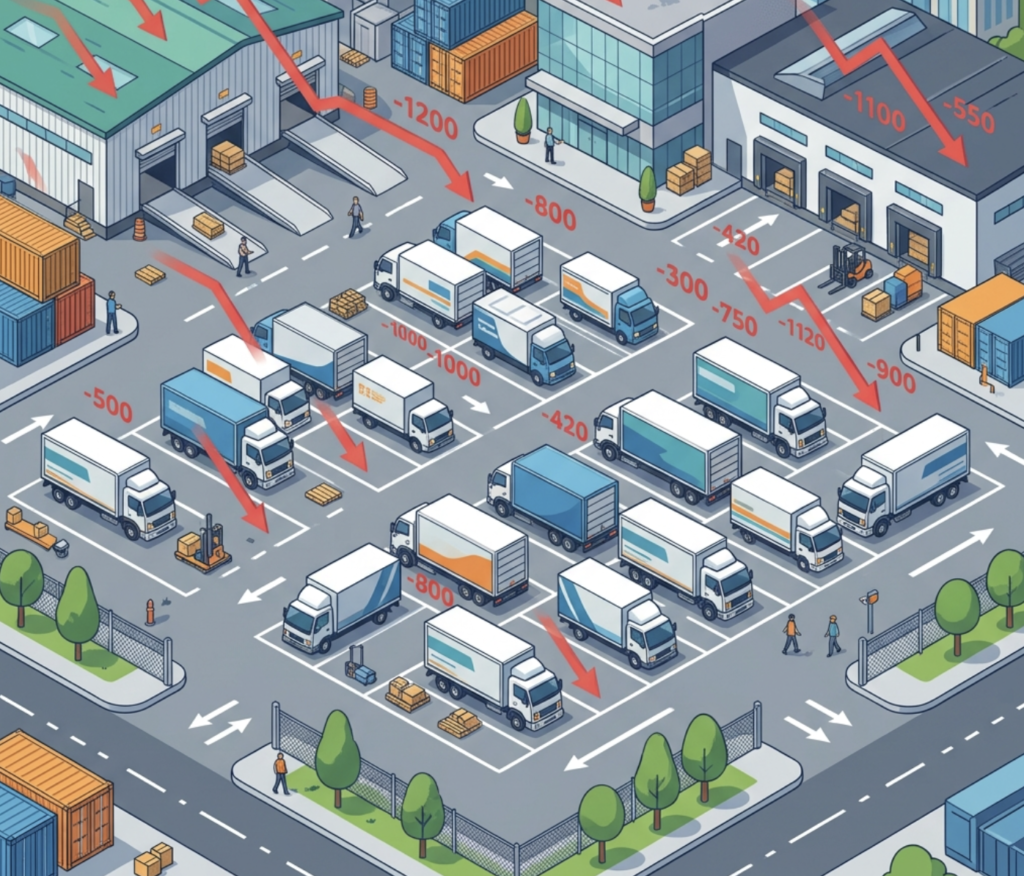
For decades, Operations Managers and Fleet Directors have equated the physical size of their fleet with the success of their company. But as margins tighten, inflation rises, and insurance premiums skyrocket, the industry is waking up to a harsh financial reality. Having a massive yard full of parked commercial trucks isn’t a sign of operational dominance—it is a massive, silent drain on your capital.
If you walk through the yard of an average mid-sized private fleet on a Tuesday afternoon, you are witnessing the most expensive problem in modern logistics: Idle Time.
The Market Reality: The 60% Utilization Trap
Most companies build their private fleets for the “just-in-case” scenario. A wholesale distributor will lease enough 26-foot box trucks to handle their absolute busiest holiday rush, fully accepting that a large portion of those trucks won’t be needed during the slower months.
Industry data reveals a stark picture of this inefficiency. Across North America, the average asset utilization rate for private commercial fleets hovers between 60% and 70%.
This means that for 30% to 40% of its usable life, a commercial truck is not generating a single dollar of revenue. Yet, the expenses attached to that vehicle do not stop when the engine is turned off.
The Math Behind a Parked Truck
Let’s look at the real numbers. What does it actually cost to leave a standard 5-ton (26-foot) commercial box truck parked in your yard?
While exact numbers vary by province and provider, the fixed monthly costs of ownership look something like this:
- Lease / Financing Payment: $1,200 – $1,800 per month
- Commercial Auto Insurance: $600 – $1,000 per month
- Routine Maintenance (Time-based decay): $150 – $300 per month
- Parking & Secure Storage Overhead: $200 – $400 per month
Total Fixed Cost: Roughly $2,150 to $3,500 per month, per truck.
That is $25,000 to $42,000 a year in hard, unrecoverable expenses. If that truck is sitting idle 30% of the time, your company is effectively lighting $7,500 to $12,600 on fire every year, per vehicle, just for the privilege of keeping it in the yard “just in case.” Multiply that by a fleet of 10, 20, or 50 trucks, and you are looking at hundreds of thousands of dollars in evaporated profit margin.
The Real Pain Points for Fleet Owners
The financial drain is only part of the problem. Over-leveraging on fleet hardware creates a cascade of operational pains:
1. Capital Imprisonment Every dollar tied up in a depreciating, parked truck is a dollar that cannot be spent on what actually grows a business: hiring better talent, investing in sales, upgrading software, or acquiring new customers. It is trapped capital that yields zero return.
2. The Maintenance Paradox Commercial trucks are designed to run. When heavy-duty hardware sits idle for extended periods, it ironically leads to more maintenance issues. Batteries die, seals dry out, and brakes seize. Fleet managers often find themselves paying repair bills for trucks that haven’t even been driven in weeks.
3. The Insurance Squeeze Commercial insurance providers do not offer “parked discounts” for the days your truck doesn’t move. You are paying premium, heavy-haul liability rates 365 days a year, regardless of your actual utilization.
Shifting the Mindset: From Ownership to Utilization
The most successful supply chain leaders are fundamentally shifting how they view their logistics operations. They are abandoning the idea that they need to own 100% of their peak-demand capacity.
Instead of leasing 20 trucks when they only need 14 on a daily basis, forward-thinking operators are building leaner, baseline fleets. When spikes in demand inevitably hit, they are turning to B2B capacity sharing, short-term commercial rentals, and peer-to-peer asset leasing to temporarily bridge the gap.
Conversely, businesses that do find themselves with excess idle vehicles are looking for ways to monetize that downtime. They are exploring B2B partnerships to rent out their hardware to other trusted local businesses, transforming their biggest liability back into a revenue-generating asset.
In the modern logistics landscape, survival isn’t about having the most trucks. It’s about ensuring that every truck you pay for is actually working for you.
Leave a Reply